


From picoseconds to decades: modelling materials for future energy

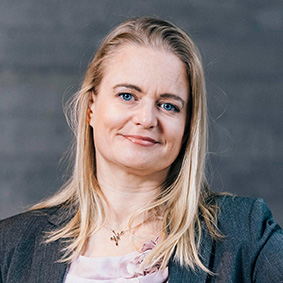
Professor Andrea Sand is joining Aalto University’s department of Applied Physics. Professor Sand uses computer simulations to study how materials behave, which is useful when the materials are subject to conditions that are hard to examine in traditional ways, like being inside the walls of a nuclear reactor, or in outer space. We spoke to her about her work:
What do you study and why?
I research how radiation affects materials using computer simulations. We do this because the processes that cause radiation damage are so fast and happen on such a small scale that it is very difficult to observe them with regular experiments, so simulations are the only way to examine them. What’s more, the situations where radiation damage is happening are too extreme to recreate safely in a laboratory, like the radiation levels in a nuclear reactor, or cosmic radiation in space. So to understand the processes and predict the possible effects, we have to model them using computers instead.
My main focus is on future applications of materials where radiation will be a key part, which includes nuclear fusion, and the next generation of nuclear fission. In existing fission reactors, the materials have been in place for decades so we can take them apart and look how they’ve changed, but for next generation reactor designs we can’t do that yet, so simulations are important in designing them.
The reason it’s important to study radiation damage is because over time, radiation changes how materials behave. For example, the thermal conductivity of a material changes over time when it is exposed to radiation. Thermal conductivity is an important property of a reactor because we need to get the heat out of the reactor to turn it into useful electrical energy. An even more important property of a reactor from a safety point of view is structural integrity. Radiation can make materials become more brittle at different temperatures than usual, so it is important to predict this so reactors can be designed safely.
A topic that I have begun to study more recently is how radiation affects semiconductors. This is relevant for improving the radiation damage-resistance of electronics on spacecraft, but also for increasing the resolution of low-temperature particle detectors, such as the ground-based semiconductor detectors used in the search for dark matter.
What interests you about the field?
The radiation responses of materials is a big constraint on future energy technologies. So the questions are important and challenging. If we manage to tackle the safety and commercial feasibility, nuclear energy from fission and fusion will be able to both meet the growing energy demand and combat climate change at the same time.
On a fundamental level I personally enjoy rigorous mathematical models, but I appreciate the ability of simulations to sit at the interface between analytical models and real world experiment. My background is in pure theoretical physics, my very first paper was on the logical foundations of quantum mechanics, to model its limits and approximations. Since then I have moved into models with more real life data and assumptions, but with more real life applications too.
What do you expect from the future
We need to be able to understand the material changes that take place at all scales, from picoseconds to decades, to be able to guarantee the structural integrity of nuclear devices throughout their whole lifetime.
Nuclear energy suffers from serious stigma because of historical missteps and a fear of the unknown. In my role as a professor at Aalto I would like to help mitigate some of the fears concerning radiation, we often forget that we are continuously subjected to small amounts of radiation, from sources that naturally occur in our surroundings. I think though that we’re on the threshold of change, primarily because of the issues of climate change, so the feeling towards it will change as society recognises nuclear energy as a clean and practically infinitely abundant energy source.
Contact information:
Read more news

Strong results from the Research Council’s winter call
A total of 54 Aalto researchers received Academy Research Fellow or Academy Project funding from the Research Council of Finland. The total funding awarded to Aalto University amounts to 33.2 million euros.
Aalto University’s solutions at the New European Bauhaus Festival support the EU’s ambition to become world leader in circular economy
Aalto University presented several different circular economy solutions at The European Commission’s New European Bauhaus Festival in Brussels. The event brought together leading names in EU policymaking, researchers, designers and grassroots actors from across Europe to shape a more sustainable future.
Iina Vaajamo appointed to a five-year fixed-term Assistant Professorship at the Department of Chemical and Metallurgical Engineering
DSc. (tech.) Iina Vaajamo has been appointed to a five-year fixed-term position as Assistant Professor in the tenure track system at the Department of Chemical and Metallurgical Engineering effective 1. September 2026. The field of the professorship is pyrometallurgy.