


Research project develops method for predicting radiation damage in semiconductors

Semiconductor materials have played a crucial role in the development of modern technology from computers to solar cells. Many equipment that are exposed to heavy particle radiation, such as satellites, nuclear reactors, and particle accelerators, also depend on semiconductor technology. Radiation damages the material though, shortening the life cycle of the equipment and disrupting its operation.
A new Aalto University research project has received €1.5 million of funding from the European Research Council (ERC) to improve the prediction of radiation damage in semiconductors. The new method could increase the lifetime of equipment and promote the introduction of new materials in various electronic components.
At the moment, radiation damage is usually predicted with empirical research results. The researchers at Aalto University aim to predict and explain the damage with the help of fundamental physics, that is, mathematical models that explain the phenomenon.
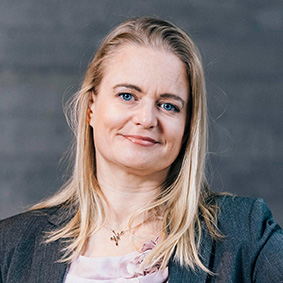
‘We will carry out computer simulations based on quantum mechanics models, which can be used to both explain and predict the formation of damage and its structure,’ says Assistant Professor Andrea Sand, who received the funding.
The researchers will compare the simulation predictions with the results of empirical tests, such as electron microscope images. This allows them to both confirm the accuracy of the simulation predictions and to produce a better understanding of the origin and nature of the damage.
‘As the simulation is based on the concepts and models of physics, it also gives us an explanation of the phenomenon at hand. That’s not always possible with just empirical experiments.’
Breaking free of the limits of today's materials
Today, silicon is the most widely used semiconductor material. It has played a key role in the dramatic increase in computers’ computing power in recent years, but we are now reaching its limits.
‘The potential of silicon has been almost fully exploited. We are now looking for new and even better materials,’ Sand explains.
Replacing silicon in applications for radiation-intensive environments is not, however, free of obstacles, as new materials’ functionality under such conditions is still largely a mystery. This is where Sand’s research can help: if the researchers learn to predict radiation damage based on mathematical models instead of empirical experiments, learning about the behaviour of new materials can become much faster and easier.
‘Determining the radiation resistance of new materials experimentally is not only expensive but also time-consuming. If—and when—we manage to reliably model the radiation damage in semiconductors that we are currently using, starting from the fundamentals of physics, we can then take the next step and make such predictions for new materials as well. Computational prediction reduces the experimental load significantly.’
The funding received by Sand is a €1.5 million ERC Starting Grant. The five-year-project will be launched next year.
Read more news

ACME at Unite! Research School 2026
Ahmed Othman and Shreeram Pillai participated in Unite! Research School 2026 in Torino and Oropa, Italy, joining an international doctoral programme focused on interdisciplinary collaboration, research communication, and academic development.
Strong results from the Research Council’s winter call
A total of 54 Aalto researchers received Academy Research Fellow or Academy Project funding from the Research Council of Finland. The total funding awarded to Aalto University amounts to 33.2 million euros.
The Foundation for the Advancement of Finnish Securities Markets awards Juho Tuuliainen and Ville Virkkunen for their excellent Master’s thesis in the field of finance
Both students will receive a €3,500 scholarship.